Posts

News summary

A sampling of some of the news out of El Salvador: Protests .  Protesters returned to the streets in large numbers again on Sunday, October 17, to protest policies of the Bukele government.   The protests were somewhat smaller than the September 15 protests.   One reason for the smaller size may have been the police and military checkpoints which went up on the major routes into San Salvador early Sunday morning, stopping all the buses.    For his part, Bukele tweeted 41 times during the day trying to suggest that the protest marches were a "failure" or that people were brought to the march without knowing what they were protesting. Journalist Roberto Valencia, in an opinion piece in the Washington Post, asked the important question "what now?"   The protests are loosely organized with no real leader and do not seem yet to lead to the creation of a political movement which might have strength at the polls in 2024. COVID-19 .  The COV...

Bitcoin and El Salvador's electric power generation

Image
Just after Nayib Bukele announced that El Salvador would be the first country in the world to make Bitcoin legal tender, he also made headlines by suggesting there was "volcano energy" to attract Bitcoin miners to come to the country. In light of the very energy-intensive nature of Bitcoin mining, it makes sense to understand the overall state of electric power generation in El Salvador.   Global bitcoin-mining currently consumes more electricity than the country of Argentina . Official data on electricity generation and use in El Salvador is maintained by Unidad de Transacciones S.A de C.V. which administers the transmission and market for electricity. As shown in the chart below, the four principal sources of electric power in El Salvador currently are hydropower, fossil fuels (primarily bunker diesel power generation), geothermal, and imports (primarily from Guatemala). Renewable sources such as solar, biomass, and wind made up a small but growing 9% of total electric...

Nayib Bukele's shadow cabinet of Venezuelan advisers

Image
A person who only casually follows news and politics in El Salvador could wonder why some marchers in recent protests carried signs denouncing Venezuelans' role in Bukele government policies.  Alongside banners decrying the authoritarian rule of Bukele or rejecting the new Bitcoin law in the country,  you might also see a denunciation of “Venezuelan interference.”      In fact, a series of reports in El Faro and other media outlets have identified a group of more than two dozen Venezuelan consultants to the Salvadoran government, several of whom act as a kind of shadow cabinet in the administration of president Nayib Bukele.   According to El Faro , the pyramid of power in El Salvador has Nayib Bukele at the top with his three brothers as his closest advisors, followed by the group of Venezuelans, who then direct the various actual cabinet ministers.   The current leader of the Venezuelan shadow cabinet has been identified as Sara Hanna Georges. ...

The World's Coolest Dictator and his Bitcoin gambit

Image
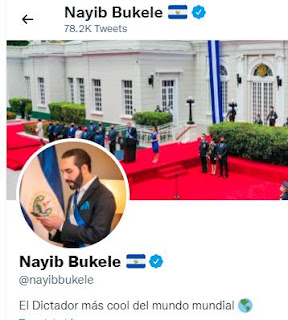
Here is another round-up of El Salvador related news in the English language press around the world.   Many of the recent headlines take off from Nayib Bukele's decision to label himself the "world's coolest dictator" in his Twitter profile.   Other articles continue the world press fascination with Bukele's Bitcoin experiment in the country.   Too little attention was paid to Bukele's overhaul of the judicial system with judges to his liking.   Nayib Bukele calls himself the ‘world’s coolest dictator’ – but is he joking? (The Guardian) “Few world leaders have navigated the Covid-19 crisis for their own political benefit better than the Salvadoran president.” Fears for democracy in El Salvador after president claims to be ‘coolest dictator (The Guardian) -- “US diplomat raises concerns after Nayib Bukele makes outlandish claim on Twitter and replaces judges to permit future re-election.” President of El Salvador rebrands himself ‘world’s coolest dic...

Judicial purge in El Salvador

Image
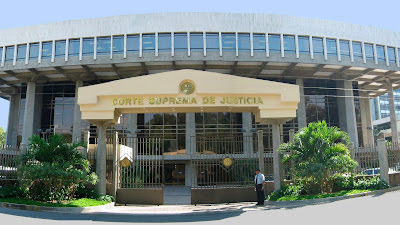
 El Salvador is currently in the midst of an ongoing conflict which will determine if the judicial branch in the country has any remaining ability to check abuses of power by the executive or legislative branches. On August 31, the Legislative Assembly adopted a measure from President Bukele to purge a significant part of the country's judges from their posts.  The changes require judges and prosecutors to retire once they turn 60 or have 30 years of service, which would remove more than 200 judges (one-third of all judges) and dozens of prosecutors.   Then the Supreme Judicial Court and the National Council of the Judiciary, filled with Nuevas Ideas appointees and allies, will be able to replace the judges with ones whom they approve.  The law also allows for re-assigning judges across the country. That law could go into effect today, September 25.  A court in San Miguel, however, has issued an order staying the law for now.  The order requires the ...

Bukele pushes back as US places top judges on "Engel List"

Image
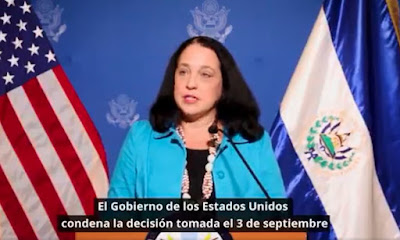
Jean Manes, Acting US Ambassador to El Salvador US relations with Nayib Bukele's government in El Salvador hit a new low this week.  The Biden administration expanded its Engel List on Monday, September 20, by adding the five magistrates of El Salvador's Constitutional Chamber to the list of corrupt actors who undermine democratic institutions. The announcement from the US State Department declared:    Elsy Dueñas De Aviles, Oscar Alberto López Jerez, Hector Nahun Martinez Garcia, Jose Angel Perez Chacon, and Luis Javier Suárez Magaña , current Magistrates of the Constitutional Chamber of the Supreme Court, undermined democratic processes or institutions by accepting direct appointments to the Chamber by the Legislative Assembly. The previous five Magistrates were abruptly removed without legitimate cause following the May 1 seating of the newly elected Legislative Assembly. After being installed, the new Magistrates declared their installation by the Legislative Assemb...

Uncomfortable journalism

Image
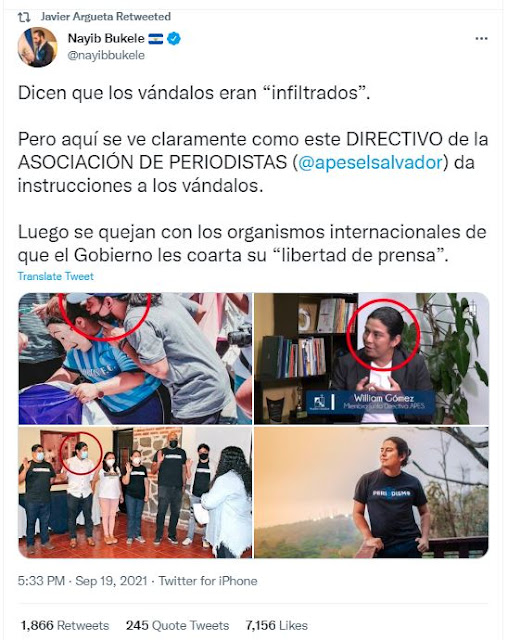
The last few days have seen the battle between Salvadoran president Nayib Bukele and the independent press in his country escalate even further. The current round began with publication of an important story by digital media site GatoEncerrado about the ruling by El Salvador's Constitutional Chamber which opened the possibility for presidents including Nayib Bukele to be immediately reelected for a second term.  That decision, which altered prior precedent and the recognized interpretation of the Salvadoran constitution has been widely criticized.   In its reporting, Gato revealed that, after the decision was signed but before it had been disclosed to the public, the office of the president was informed of the decision.  The legal assistant to the president, Javier Argueta , contacted the magistrates of the Supreme Electoral Tribunal (TSE) and asked for a meeting. The TSE is the body which oversees Salvadoran elections and decides who can run for office. Argueta co...