Posts

Will US ever acknowledge its role in past human rights violations in El Salvador?

On March 24 in Argentina, US president Barack Obama  said to the Argentine people that he regretted  the slowness of the US on human rights during the 1970's during the "Dirty War" in Argentina.   During that dark time, Argentina's military was responsible for abducting, torturing, and killing tens of thousands of suspected opponents. On April 15, Raymond Bonner wrote in The Nation that it is time the US did the same for its involvement in El Salvador's civil war and the atrocities committed by the right wing government with US backing.  He writes: In Argentina, the security forces killed some 30,000 civilians. In El Salvador, more than 75,000 lost their lives during the civil war, which lasted from 1980 until the 1992 peace agreement. The guerrillas committed atrocities, but the United Nations Truth Commission, established as part of the accord, found that more than 85 percent of the killings, kidnappings, and torture had been the work of government forces, ...

Catholic archbishop issues pastoral letter on violence

San Salvador Archbishop Jose Luis Escobar Alas has issued a major Catholic teaching document, called a pastoral letter, on the subject of the gang violence plaguing El Salvador, which has given the country one of the world’s highest homicide rates. [ Click here for a complete translation of the document .] The pastoral letter, called “ I see Violence and Strife in the City ” is Escobar’s first, and is being whispered about in San Salvador Catholic circles as possibly constituting the most important pronouncement from the Church in decades. [ Read about the letter’s inspiration in Oscar Romero .] In the Letter, Archbishop Escobar concludes that El Salvador’s violence is driven by systematic social injustice and that it “has roots that can be traced back to colonial days” ( Violence and Strife , par. 63.).  Power groups in El Salvador have imposed unjust arrangements over other groups through violence, creating a dynamo of violence that has operated continually through the c...

Orange alert for water shortages in El Salvador

On Thursday the government declared an orange state of alert for water shortages throughout the country, which the government said were caused by climate change and the poor state of the country's systems for obtaining and distributing potable water. The primary areas affected by the water shortages are the greater metropolitan area around San Salvador where the largest percentage of the country's population resides.   In recent months, there have been increasing scenes of protests where residents block major roads to highlight the fact that their neighborhoods have been without potable water for weeks or months.   Families are paying as much as $45 per month to buy water from private tank trucks when the public water supply disappears. The government says that the country has received below average rainfall for the past four years.   Wells which supply the metropolitan area are producing water at reduced levels. The country's water distribution system is showing ...

Corruption investigations in El Salvador

It may be getting tougher to get away with corruption in El Salvador.    Investigative journalism by online journalists like those at El Faro and RevistaFactum  are regularly describing corruption.    The Probidad division of El Salvador's Supreme Court has open investigations against at least 9 high public officials including two former presidents.   El Salvador's new attorney general Douglas Meléndez has shown a willingness to pursue cases of corruption involving figures on both sides of the political spectrum.    In twelve years of writing this blog, I don't think the amount of corruption has changed over that time.   But the amount of news coverage and the number of possible prosecutions certainly has increased in the past few years.   That's a good thing. As the most recent example, the online periodical El Faro is one of the periodicals world wide participating in the disclosure of the so-called "Panama Papers."   Th...

A new phase in El Salvador's security struggle

The struggle to bring an end to homicidal violence in El Salvador entered a new phase last week.  The country's National Assembly approved a set of extraordinary measures aimed at gang leadership in the country's prisons.   Details of the legislation  include reductions or eliminations of family visits (often used to send messages to gangs in the streets), the elimination of cell phone service in the areas around prisons (contraband cellphones are used by gang leaders to communicate with those outside), the transfer of gang leaders to a maximum security prison where solitary confinement and other measures are approved, and the suspension of transportation of prisoners to court hearings. The country's cell phone companies announced that they were complying with the legislation and apologized to their customers who might live next to a prison and who would also be cut off form service. In addition to the measures targeted at the prisons, the government of Salvador Sá...

Gangs and government agree -- gangs control homicide level in El Salvador

Image
As El Salvador's government moves forward with new measures trying to control gang violence in the country, the powerful gangs which control many neighborhoods released videos declaring a temporary halt to killings. From the Associated Press : In the video broadcast by local media Saturday, a masked man claimed to make the offer on behalf of the Mara Salvatrucha gang and two factions of the Barrio 18 gang.  The video said killings were ordered stopped as of Saturday, to show the government it didn't have to implement get-tough policies. The government has been considering a kind of limited state of emergency in some areas, and is planning to release some non-gang inmates to free up prison space and liberate police to fight the gangs.  "We have ordered all of our people ... to halt all types of homicides nationwide," said the man who appears in the video, "to demonstrate to the public, the government and international agencies in our country that ther...

If Romero had lived

Image
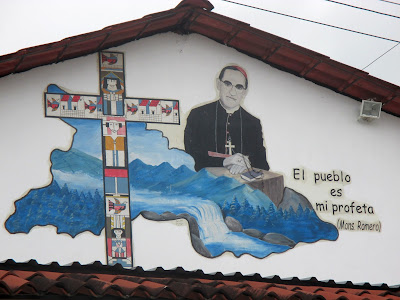
Today, March 24, is the 36th anniversary of the assassination and martyrdom of Salvadoran archbishop Oscar Arnulfo Romero.   He was slain by a marksman's bullet as he said mass in the chapel at the Divina Providencia cancer hospital in San Salvador.   Today he is officially called "Blessed" after his beatification by the Roman Catholic church on May 23, 2015. To mark the anniversary, our friend Carlos Colorado has a blog post titled Blessed Romero's Unfinished Eucharist .  Carlos looks at what Romero was planning for the days and weeks following March 24: In February 1980, Romero attended a spiritual retreat during which he examined his life and he resolved to take various steps to either address perceived failings, or to continue on the path that he had assessed to be the right path upon reflection. Romero devised a plan of action that included the following near term plans: Romero intended to write a fifth pastoral letter on the subject of evangelizati...