Posts

Showing posts matching the search for IPAZ

IPAZ calls for peace dialogue with gangs

Image
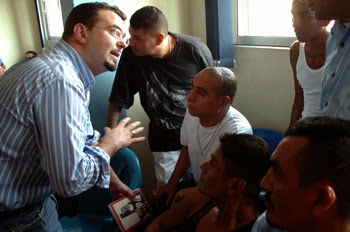
Salvadoran church leaders who are part of the Pastoral Initiative for Life and for Peace (IPAZ) held a press conference, on Wednesday, April 29,  to advocate for dialogue in the face of growing violence in the country.   IPAZ called for a process of national dialogue, including dialogue with the country’s gangs, as the only path forward to achieve peace in the country afflicted with so much violence. Text of IPAZ press release . The IPAZ press conference followed a week after a joint communique purporting to come from the imprisoned leaders of the country’s largest gangs was released to the public.   The statement indicated agreement to a 26 point “peace process” proposed by Raul Mijango, one of the mediators of the original truce, including the gangs’ agreement to unilaterally reduce the level of violent acts being committed against the population, including attacks on the police and military. According to a person with knowledge of the process, Raul Mijango h...

Voices crying in the wilderness

Image
I have written several times on this blog about IPAZ, the pastoral initiative for life and peace, a group of protestant churches in El Salvador which advocates for dialogue in Salvadoran society, including dialogue with the gangs, as a path towards reducing violence in the society. On October 27, the churches organized a march in San Salvador which included family members of gang members.   The marches ended at Plaza Salvador del Mundo where the church leaders called out for a cessation of violence in the country.   In particular, the IPAZ churches called for the gangs to: a)  cease all violent actions against the lives of Salvadorans b)  cease recruiting members, especially boys and girls c)  cease all types of threats which force families to leave their homes or neighborhoods d)  permit the free transit of people throughout all El Salvador In an interview given to the online periodical RevistaFactum after the march, Lutheran Bishop Medardo Go...

Pastoral initiative for peace

Image
A group of churches in El Salvador yesterday made public their proposals to the government for working on the problem of gang-fueled violence in El Salvador.   Calling itself "IPAZ," the Pastoral Initiative for Life and Peace, the group of Protestant and Catholic churches propose a "tridimensional dialogue" between the churches, the gangs and civil society to seek an understanding for a reduction in the levels of violence and homicides.  IPAZ proposes to be the facilitator of this process. The church leaders do not describe this process as a continuation of the so-called truce process, but instead an attempt to rescue those pieces of that process which had produced positive results.   They expressed a certainty that there were various gang members who truly did want to give up lives of crime.   IPAZ stands opposed to those who would say there can be no dialogue with the gangs. IPAZ specifically does not call for the government to negotiate with the gangs or...

Of gangs, anti-crime plans, and dialogue

Whether you should "dialogue" with gang members or shoot them on sight is an active debate in El Salvador.   The debate is front and center as the year began with a spate of murders of police followed by a purported unilateral cease fire by some of the country's gangs. Protestant churches which make up the IPAZ effort favor an approach to the country's gang problem which includes dialogue with the gangs.   Leaders of the churches were making visits in January to prisons in El Salvador which they characterized as "pastoral,"  including worship services.  The churches pointed out that they were not negotiating with the gang leaders they met since the churches have no authority from the government to act as mediators. Coincidentally or not, around the same time as the IPAZ efforts, the gangs announced a unilateral ceasefire.  The rates of murder and some other crimes seemed to drop immediately , and El Salvador experienced its first day without a murder i...

A Christmas Plea for Peace

Sometimes, at this time of year, we need to be improbably hopeful.   From WorldCrunch Spotlight: El Salvador, A Christmas Plea for Peace : Make it stop! That’s the message delivered this week by an organization of Protestant churches in El Salvador, Central America’s smallest but deadliest country.  The group, known as the Pastoral Initiative for Life and Peace, or IPAZ, is hoping that for the week between Christmas and New Year, gang members, security forces, operatives of so-called death squads and others responsible for the nation’s horrific homicide numbers will accept a temporary “peace pact.”  “This time of year lends itself to concrete gestures of peace. This may not be an open war. But the violence is killing us,” IPAZ declared in a statement released Tuesday .

El Salvador's government ponders extraordinary measures to combat crime

El Salvador's top government leaders have been meeting to consider implementing "extraordinary measures" including the possible declaration of a "state of exception" to combat gang violence.  A declaration of a state of exception could involve the suspension of certain constitutional protections, the imposition of curfews, and the ability to detain persons without cause for extended periods of time. InsightCrime reported : On March 8, El Salvador 's Supreme Court, President Salvador Sánchez Cerén, and lawmakers considered a plan to implement a state of exception in the country's most violent municipalities, reported La Página . The proposed state of exception would likely affect at least ten municipalities, including the capital city of San Salvador. If implemented, the state of exception would provide authorities with broad powers to suppress public meetings, restrict freedom of movement, and monitor mail, e-mail, telephone, and social media com...

Seeking paths for peace

Image
Voices were heard in El Salvador this week looking for alternative ways to end the cycle of gang violence in the country. On Monday, the government released its draft proposal of a law for rehabilitation and "re-insertion" of gang members into society.  In announcing the proposal , the Minister of Justice and Public Security, Benito Lara, stated that the law was aimed at youth who had come under the influence of the gangs, to give them a reason to make the decision to exit.  The law would seek to slow the growth of gangs through programs of formal and informal education, job creation, and productive projects leading to a culture of peace.   Lara emphasized that this law did not provide for amnesty for gang members, nor was it directed at those who had committed serious crimes.   The law now goes to the National Assembly for debate, where a central question will be how to finance the programs. On Tuesday, marchers converged on Plaza Salvador del Mundo clamoring ...

Violent deaths in El Salvador decline in November

Looking for any glimmer of improvement in the wave of murders which has hit El Salvador this year, Salvadorans heard from the PNC yesterday that "only" 139 people were murdered in the first ten days of November, for an average of 13.9 per day.   This compared to an average of 22.7 per day during October. While acknowledging this was a reduction, Howard Cotto of the PNC cautioned that it was too early to be labelled a trend.   While refusing to disclose particular police strategies, Cotto believes that actions by security forces are having a positive effect. At the same time, Cotto dismissed the idea that the reduction in homicides represented a response by the gangs to the call of the IPAZ churches for the gangs to cease their violent actions.  The churches, for their part, see the reduction in homicides as a response to their call for peacemaking. Cotto repeated the claim of the government that most of the victims and most of the killers were gang members.  ...

The Attorney General and the Supreme Court

This week, the number of homicides for August  surpassed 700 , making this easily the bloodiest month in the bloodiest year since the end of the civil war.  It was a week which saw El Salvador's Attorney General Luis Martinez and the Constitutional Chamber of the Supreme Court making news related to the struggle to control gang-related violence. It's terrifying, but are gangs terrorists?   The Constitutional Chamber released a ruling which addressed issues surrounding a El Salvador's anti-terrorism law and anti-gang legislation.   According to the court's ruling, the warring street gangs can properly be called terrorists under the law, and  membership in the gangs alone is sufficient to be considered a crime.   The law should not, however, be extended to those who commit acts of protest, so long as the purpose was not the use of terror and violent acts.   The ruling said the government can properly prosecute those who was are financiers or apologist...

Threats to truth tellers

In recent weeks, El Salvador has seen a disturbing rise in threats and insinuations against those who would insist on exposing the truth, or advocating a path other than the government's open fire approach to combating the gangs: Journalists at El Faro have  received threats  and report being followed following their reporting on police abuses in torturing detainees and extra-judicial killings.   Some of the reporters for the periodical left the country for their own safety. Pastor Mario Vega of the ELIM evangelical mega-church in El Salvador announced that he had been receiving death threats  for his criticisms of the government's approach to policing as being ineffective.   Pastor Vega recently expressed his concern that a church evangelist had been arrested and held without charge because gang members attended a religious event she was holding in her house. The country's attorney general attacked church leaders in the IPAZ movement who have been vocal...

Top 10 religious stories from 2015 in El Salvador

This is our annual year-in-review guest post from Carlos Colorado, author of the Super Martyrio blog , and expert on all things related to Oscar Romero. Here is a roundup of what I consider the top ten religious stories in El Salvador for 2015. As always, more than purely religious stories, I sought to canvass the year’s news for stories that show how El Salvador’s soul was tested and (sometimes) soothed last year. 1. Oscar Romero beatified . The beatification of the archbishop martyred for defending the poor is more than doing justice by a good man. It was a moral declaration of right and wrong that will dictate historical analysis of the Salvadoran Civil War. [ More over at my blog .] 2. Officialdom balks at bold IPAZ peace initiative . The carnage caused by the Salvadoran gang problem is the worst since the Civil War, but the idea of negotiating with the gangs has proven to be too much of a bitter pill for society and elected officials to accept. 3. Catholic child ab...

Gangs announce a new phase of the truce

Communications issued by El Salvador's largest gangs this weekend declare that the gangs have decided to relaunch the truce process which started in March 2012, but seemed to have largely fallen apart two years later. From Reuters : Leaders of El Salvador's major gangs on Friday said their members would no longer attack police and the military in a bid to revive a tattered gang truce and slash high rates of violence that have rocked the Central American nation.  Kingpins of five Salvadoran gangs, including Barrio 18 and its rival Mara Salvatrucha (MS-13), said the agreement was reached last Sunday to relaunch a March 2012 truce that cut homicide rates by 40 percent. A report from  al Jazeera  described the communique from the gangs: "We are all victims of the situation of violence that afflicts the country, and we can't see positive results if we do not promise our determined collaboration," said the leaders.    It said gang members would also seek to avoid ...

Catholic archbishop issues pastoral letter on violence

San Salvador Archbishop Jose Luis Escobar Alas has issued a major Catholic teaching document, called a pastoral letter, on the subject of the gang violence plaguing El Salvador, which has given the country one of the world’s highest homicide rates. [ Click here for a complete translation of the document .] The pastoral letter, called “ I see Violence and Strife in the City ” is Escobar’s first, and is being whispered about in San Salvador Catholic circles as possibly constituting the most important pronouncement from the Church in decades. [ Read about the letter’s inspiration in Oscar Romero .] In the Letter, Archbishop Escobar concludes that El Salvador’s violence is driven by systematic social injustice and that it “has roots that can be traced back to colonial days” ( Violence and Strife , par. 63.).  Power groups in El Salvador have imposed unjust arrangements over other groups through violence, creating a dynamo of violence that has operated continually through the c...

Padre Toño rejects gang-related charges as political persecution

Image
The arrest of Spanish priest Father Antonio Rodriguez in El Salvador, better known as Padre Toño, has prompted surprise and protests, spreading all the way to Spain. The charges against Padre Toño are illicit associations, influence peddling, and bringing contraband to persons in prison.  At a hearing on Friday, the prosecutors detailed their charges : The Prosecutor's Office say the priest had been under investigation since March 2013.  "After monitoring his phone calls, we gathered evidence of his links with the leader of the 18th street gang, Carlos Ernesto Mojica Lechuga, who is in jail" said prosecutor Allan Hernandez.  "He was doing whatever Mojica Lechuga asked him to do," Mr Hernandez added. Prosecutors say the priest successfully intervened to have a gang member transferred to a different jail at the request of Mojica Lechuga.  He has also been accused of smuggling mobile phones and other objects to gang members in prison. One of the phon...

Tackling El Salvador's gang violence

Image
August 2015 is about to conclude as the month in which more Salvadorans died violent deaths than any other month since the end of the civil war in 1992 . The primary source of killing comes from the country’s powerful street gangs and the government’s heavily armed response to it. The weapons and the death toll resemble war, even if the gangs should not be mistaken for an army. I regularly am asked what the solution should be. I really have no basis to answer except as a longtime observer of these problems in El Salvador. I have no background in law enforcement or violence prevention. But with those caveats in place, I can also say that I have seen no evidence that anyone else making policy in El Salvador seems to have the solution either. What follows is my modest attempt to describe a path towards addressing the problems of gang violence in Salvador. It seems to be accepted fact that the top leaders of El Salvador’s rival gangs are all in prison. It also seems to be a...

A new phase in El Salvador's security struggle

The struggle to bring an end to homicidal violence in El Salvador entered a new phase last week.  The country's National Assembly approved a set of extraordinary measures aimed at gang leadership in the country's prisons.   Details of the legislation  include reductions or eliminations of family visits (often used to send messages to gangs in the streets), the elimination of cell phone service in the areas around prisons (contraband cellphones are used by gang leaders to communicate with those outside), the transfer of gang leaders to a maximum security prison where solitary confinement and other measures are approved, and the suspension of transportation of prisoners to court hearings. The country's cell phone companies announced that they were complying with the legislation and apologized to their customers who might live next to a prison and who would also be cut off form service. In addition to the measures targeted at the prisons, the government of Salvador Sá...

El Salvador Gangs and Security Forces Up the Ante in Post-Truce Battle -- InsightCrime

This article was originally published on October 22 on the website of InsightCrime Written by Steven Dudley Since the dissolution of the gang truce, assassinations of police and military personnel and clashes between gangs and security forces have changed the security equation in El Salvador , closing any small window left to revive the short-lived and highly criticized ceasefire. As of October 17, the violence had left 31 policemen and various military personnel dead in 2014, including six police in October alone. The victims range from low- to high-ranking members of the security forces and are spread across a wide geographic area. This gives the impression that they were not pre-selected or targeted, but rather were killed when the opportunity presented itself, or following security force disputes with local gang factions. Clashes between security forces and gangs are also on the rise, officials in the police and army told InSight Crime. The police have reported 130 clashes wit...

The aftermath of the gangs shutting down the transport system

The final days of July saw the bus system of greater San Salvador shut down as El Salvador's powerful gangs threatened death for any bus drivers who ventured out on their routes.   It was a powerful show of power by the maras .   And it has the country's government on the defensive to try and explain why the gangs seem ever more powerful and the toll of victims is ever increasing. Al Jazeera produced a video report with a good overview of the situation.   The Washington Post also tried to summarize the situation in a piece titled Driving a bus is a death sentence in El Salvador's capital city .    But if you read Spanish, the best analysis, as always, came from El Faro in an analysis by Roberto Valencia providing ten answers to help understand the bus stoppage.   Among the points made by Valencia: The stoppage was initially the product of all three main gangs, but after Tuesday, only the 18 Revolucionario gang was continuing to prevent buses from run...