Posts

Jesuits petition for release of one of the assassins

Image
Jesuits at the University of Central America petitioned this week for the release of former Col. Guillermo Benavides, who had been returned to prison after the 1993 amnesty law was nullified last year.  From the AP : Benavides and a lieutenant, both members of an elite, U.S.-trained battalion, were convicted in the killings but then freed under a 1993 amnesty decree covering crimes during the Central American nation’s civil war. The Supreme Court declared the amnesty unconstitutional in 2016, and Benavides returned to prison despite appeals from his lawyers.  Jose Maria Tojeira, a priest who directs the university’s Human Rights Institute, said there several reasons for seeking Benavides’ freedom.  “We are aware of his regret and his admission of the error,” Tojeira said, adding that the 74-year-old ex-soldier “no longer represents a danger to the Salvadoran people.” Tojeira also said the Jesuits believe Benavides is a “scapegoat” for those who ordered the massacre...
Central American Minors Program up in the air

Image
When Donald Trump issued executive orders suspending refugee admissions into the United States, one of the affected programs was the Central American Minors program ("CAM").    This program was intended to provide a safer route to the US for children in Central America fleeing violence.   Rather the making the perilous journey through Mexico, minors with a parent legally in the US (including on TPS) could apply for refugee status in their home country and later, if approved, fly to the US to join their parent.    A recent story by PRI describes the need for the program and the impact of the program's uncertain future.  The program's impact is told through the story of Juan, a Salvadoran youth whose life was imperiled by gang death threats: Juan's family initially decided he should make the trip to the US. They thought he would have a good chance at gaining asylum, and his mother would be there to receive him. But he only made it as far as Mexico, wh...

Corruption made easy

The investigative journalists at El Faro have published a report on a parallel secret set of financial records used by ARENA presidential administrations of Calderon Sol, Flores and Tony Saca.    The records reflect money diverted from the government to many purposes: Between 1994 and 2006, the Presidency of the Republic maintained a register parallel to the official one in order to hide the true use of hundreds of millions of dollars. Two accounting books to which El Faro had access detailed how the last three governments of ARENA utilized 322 million dollars, and more than half of this amount corresponds to checks paid to the order of ex-presidents Armando Calderón Sol, Francisco Flores and Antonio Saca. The El Faro reporting goes on to describe how the various presidents over the course of twelve years hid how they used "discretionary" funds of the presidency.  In additions to payments to the presidents themselves, millions were paid out in bonuses to government of...

US guns help fuel El Salvador's violence

Image
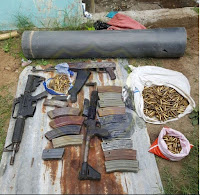
There were 4279 murders committed with firearms in El Salvador during 2016.   That was 81% of all murders committed.    When a gun is the murder weapon, chances are the gun originated in the United States. An article at The Trace titled  American Guns Drive the Migrant Crisis That Trump Wants to Fix With a Wall , argues that lax US gun control policies fuel both violence in Central America and the migrant crisis formed of persons fleeing that same violence.   Trump's commitment to gun rights may be working at cross purposes with his goal to shut down migration from south of the US border.   Weapons seized by Salvadoran  police on May 23 The article describes the smuggling networks which buy guns at US gun shops and move the guns south towards Central America: Mexico, Honduras, Guatemala, and El Salvador each tightly restricts civilian gun ownership. The smaller Central American nations have no domestic firearms industries to speak of. But o...

MS-13 in the news

When US president Donald Trump and Attorney General Jeff Sessions talk about southern border enforcement, they often bring up the gang MS-13 as the prime example of "bad hombres" who will be blocked from entering the US and be deported if they are already in the country.   MS-13 plays a role in their rhetoric similar to ISIS -- a threat to the US homeland which must be met by tough measures to block the entrance of refugees and others fleeing violence, and which requires aggressive law enforement strategies at home.     It is a theme playing out in US headlines and social media memes; in the last few days alone there are dozens of stories about MS-13 violence in the US. This week, the Republicans again blamed the Obama administration for the presence of MS-13 gang members in the country.   Senator Ron Johnson (R-Wis.), chairman of the Sentate Committee on Homeland Security and Governmental Affairs, sent a letter to the Director of the Office of Refugee Resettlemen...

Collateral damage from banning gold mining

Image
Many people around the world celebrated when El Salvador became the first country to ban all metallic mining including gold mining.    In tiny El Salvador, with limited water resources free of contamination, the threat of environmental degradation from mines was seen as too great.   Add to that, most believed that the economic benefits would only go to the multi-national companies which would own and operate the mines. But an article in the Guardian reminds us that there is another class of gold miners in El Salvador.  "Artisanal" gold miners, who dig for gold by hand from small, older mines, will soon be put out of business by the new law.   As one of these miners stated: “We’re lucky if we get $20 or $40 every two days. There are weeks when we don’t find any gold,” he says. Soza has worked all his life as a güirisero, the Salvadoran term for a small-scale, artisanal miner. He works five days a week inside an underground mine, dragging carts filled with h...

Pope Francis names first cardinal from El Salvador

Image
Pope Francis has named the first cardinal of the Roman Catholic church from El Salvador.  Seventy-four year old Gregorio Rosa Chávez is the auxiliary bishop of San Salvador and will now wear the red hat of the princes of the church.     Rosa Chávez was named auxilliary bishop of San Salvador in 1982, a post he has held for the past thirty-five years under a series of archbishops in San Salvador. From Crux , a Catholic website: On choosing Rosa Chávez from El Salvador, the pope bypassed the titular archbishop of the diocese, José Luis Escobar y Alas, once again making the point that when he gives red hats, he’s more than willing to go beyond the traditional “cardinal sees,” something he’s done in the previous three consistories he’s celebrated.  This pick in particular says a lot about Francis, because Rosa Chávez was a close collaborator of slain Archbishop Oscar Romero, who was murdered in 1980 while he was saying Mass.  Talking to Vatican Radio in t...