Posts

Where gang violence does not exist

PRI published a report today on small towns in the department of Chalatenango where the gang violence which afflicts many other areas of El Salvador is nonexistent.   The towns share a history of bloodshed during El Salvador's civil war and community organization dating back to organized opposition during the war years: There are about a dozen towns in Chalatenango where crime has been largely non-existent. They all share a history of massacres and civic participation. These towns are also small, with populations of about 4,000. For the most part, they’ve remained isolated from the rest of the country, along long and curvy roads. But that’s starting to change.  Another 45-minute drive away from San Antonio de Los Ranchos, along a brand new highway, is the town of Nueva Trinidad. On a recent day, residents from a handful of nearby communities met here to discuss their public security strategies.  Teachers spoke about the need for after-school workshops to keep kids...
A bleak picture is worth a 1000 words

Image
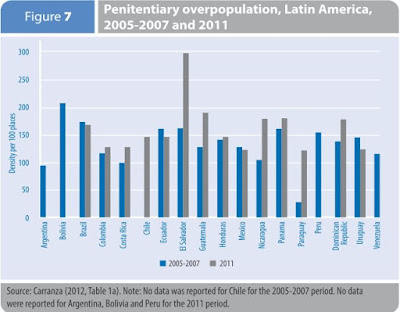
According to a 2013 report on citizen security from the United Nations Development Program, El Salvador's prisons are the most over-crowded prisons in the Americas.   This graphic shows El Salvador's dramatic increase in overcrowding from 2005-2011 in comparison to other Latin American countries: In 2012, ElFaro ran a graphic photo gallery on prison conditions and overcrowding.  Today in a photo gallery titled Here are the jails of El Salvador, the worst in America , ElDiario.es republished many of those photos again bringing into vivid detail the dehumanizing impact of such extreme overcrowding. The photos tell better than words why the idea of rehabilitation inside these prisons is far-fetched.   Detect language Afrikaans Albanian Arabic Armenian Azerbaijani Basque Bengali Belarusian Bulgarian Catalan Chinese (Simp) Chinese (Trad) Croatian Czech Danish Dutch English Esperanto Estonian Filipino Finnish French Galician Georgian German Greek Gujara...

US State Department issues new El Salvador Travel Warning

The US State Department has issued a new travel warning for those considering visiting El Salvador. The basic message is unchanged from similar advisories in prior years:  there is a lot of crime in El Salvador and travelers should take precautions to avoid being victims: Tens of thousands of U.S. citizens safely visit El Salvador each year for study, tourism, cruise ship visits, business, and volunteer work. There is no information to suggest that U.S. citizens are specifically targeted by criminals; however, crime and violence are serious problems throughout the country. Since January 2010, 34 U.S. citizens have been murdered in El Salvador including a nine-year-old child in December 2013. During the same time period, 419 U.S. citizens reported having their passports stolen, while others were victims of violent crimes.  Typical crimes in El Salvador include extortion, mugging, highway assault, home invasion, and car theft. There have also been cases reported in which ...

New York Times on US response to Central American migration

Last week the New York Times published an editorial regarding continued Central American migration towards the north.   The editorial included this commentary: Yet American politicians have shown little interest in devoting resources to address the underlying reasons Central Americans continue to head north. They include gang violence, chronic poverty, high unemployment and weak government institutions. Last year, Obama administration officials studied closely where the most recent migrants were coming from in drawing up a plan to improve the region’s economies and curb violence.  The Obama administration asked Congress for $1 billion for the effort, arguing that the border crisis last year underscored the severity of problems in El Salvador, Honduras and Guatemala, the countries where most of the migrants come from.  Last week, congressional appropriators in the House of Representatives marking up the bill that allocates foreign aid set aside less than $300 millio...

A Boy, A Girl, A Computer

Image
The  Ministry of Education  in El Salvador is rolling out a program titled "A Boy, A Girl, A Computer" in the public schools.   The government of El Salvador is receiving from Venezuela 50,000 "Lempitas" notebook computers through the  Alba Foundation  which is funded with Venezuelan oil revenue. From  TeleSur : With the program “One kid, one computer” the Salvadoran government aims at delivering computers to over 2,500 public schools throughout this year. “Today is a historical day for #ElSalvador's Education System. We begin the program: one girl, one boy, one computer,” [president] Sanchez Ceren wrote on his Twitter account....  By the end of the year, the Salvadoran government aims at providing computers to 84,396 students and 1,000 teachers. The program also contemplates providing internet access to all the public schools in the country.  Taiwan and the United Nations Development Program are also helping El Salvador in the impl...

Initial small changes to conditions in cane fields

In the Christian Science Monitor today, Whitney Eulich provides news of some initial attempts in El Salvador to change the working conditions in sugar cane fields as a way to combat chronic kidney disease and other work related illness: While scientists and health organizations around the world work to identify the root causes, a handful of power brokers here – from a top businessman to government officials and community leaders – are starting to take action to reverse the trend, based on what they know. Masariego is part of the first scientific intervention among sugar cane workers aimed at determining if work-related conditions such as dehydration or heat stress play a part in chronic kidney disease (CKD). And the achingly simple changes being tested here could serve as a model for other employers and governments across Central America, helping to raise awareness of worker protection and human rights.    “We need to do more research to find the causes, but meanwhile we...

Constitutional Chamber strikes again, stops Salvadoran government borrowing

The Constitutional Chamber of El Salvador's Supreme Court has again issued a ruling which has again angered the other branches of the government.    The Chamber has issued an order preventing the government from issuing bonds to borrow $900 million needed for the functioning of the government and planned spending on citizen security and social programs.  The order remains in effect while the court considers a challenge to how those bonds were approved in the National Assembly. El Faro described the legal challenges here .   The bonds originally failed to pass by one vote of the super majority needed to approve such borrowing.   The website for the National Assembly indicated that the measure was then removed from the legislative calendar and sent to archive.   Later that night, the GANA deputy who had abstained from voting for the measure departed.    A back-up deputy from GANA took her place.   The bond approval measure was recalled to the...