Posts

Looking back at the constitutional crisis

El Salvador's constitutional crisis is officially over.  The National Assembly has re-elected the magistrates to the classes of 2006 and 2012.  The four judges of the constitutional chamber including Belarmino Jaime continue with their roles set out in El Salvador's constitution.  The Supreme Court has a new President, Salomón Padilla. What are the lessons of this protracted crisis? A victory for constitutional order .  The resolution of the crisis represented a vindication for the Constitutional Chamber.  The National Assembly and President Funes were forced to re-elect magistrates to the Supreme Court in compliance with the rulings of the Constitutional Chamber.  The politicians were forced to back down from their attempt to transfer Belarmino Jaime out of the Constitutional Chamber, a move the Chamber had ruled violated the constitution.  Thus El Salvador moved a step forward toward having a societal consensus that the Supreme Court, and in parti...

New York Times on gang truce

The New York Times ran an article today on the ongoing gang truce in El Salvador, titled  In El Salvador, Violence Falls Amid a Gang Truce .   The article provides an overview of the truce between El Salvador's two major gangs which has managed to last for more than five months.  Here's an excerpt: At the first truce meeting, hot stares fed the tension, according to those present. About 200 soldiers stood nearby in case the sit-down dissolved into bloodshed and ignited the thousands of gang members that the leaders command from behind prison walls.  These prisoners, some branded head to toe with gang tattoos, now speak of a new day. They raise the prospect of working instead of stealing to make ends meet. They liken the truce, however fragile, to the peace accords that halted the 12-year civil war here in 1992.  “We have shown good will,” said Victor Antonio García, a Barrio 18 leader deported from Los Angeles. “But now the government has to get involved....

Quijano to be ARENA's 2014 presidential candidate

Image
The next presidential election in El Salvador will not be until March 2014, but we already know the candidates for El Salvador's two leading political parties. This week the right wing ARENA party announced that its candidate will be Norman Quijano, the popular mayor of San Salvador. Earlier this year, Quijano won election to a second term as mayor by a landslide. As mayor of the country's largest city, he has already shown the ability to gather significant support and is viewed as someone able to get things done. The FMLN had earlier announced that its candidate will be Salvador Sanchez Ceren, the current vice-president.

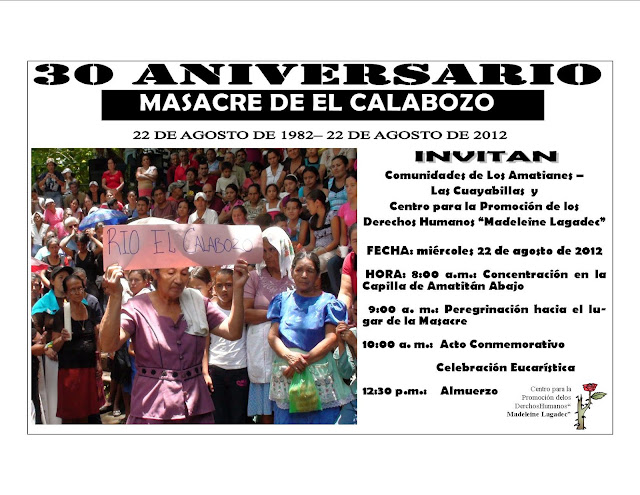
The massacre at El Calabozo

Image
On Wednesday August 22,  people will gather at the church in Amatitán Abajo, in San Vicente Department, to commemorate, remember and demand justice for a massacre which happened thirty years ago.   It is the anniversary of the El Calabozo massacre, when troops of the US-trained Atlacatl Battalion murdered more than 200 civiliam victims taking refuge along a river's banks. The massacre was documented in the UN Truth Commission Report following the signing of the 1992 Peace Accords: On 22 August 1982, in the place known as El Calabozo situated beside the Amatitán river in the north of the Department of San Vicente, troops of the Atlacatl Rapid Deployment Infantry Battalion (BIRI) killed over 200 men, women and children whom they were holding prisoner.  The victims had converged on El Calabozo from various directions, fleeing a vast antiguerrilla military operation which had begun three days earlier in the area of Los Cerros de San Pedro a...

Agreement reached to end constitutional crisis

After 17 negotiating sessions presided over by president Mauricio Funes, the leaders of El Salvador's political parties have reached an agreement which would appear to bring an end to El Salvador's ongoing constitutional crisis.   The agreement apparently came when the parties agreed to elect José Salomón Padilla as president of the Supreme Court and the Constitutional Chamber, in place of Ovidio Bonilla who had been elected in April.   Belarmino Jaime and the other judges elected to the Constitutional Chamber in 2009 will continue in those roles. The judges originally elected in 2006 and 2012 will be re-elected. The announcement from the office of president Funes, and a copy of the agreement signed by the parties can be seen at  this link . I'll have some analysis about what this resolution means for Salvadoran democracy and governance in a later post. *Hat tip to Carlos

CACJ rules -- and the negotiations continue

The Central American Court of Justice (CACJ) issued its ruling on the constitutional crisis in El Salvador.   The CACJ ruled in a 5-1 decision, that the decisions of El Salvador's Constitutional Chamber, which invalidated the elections of magistrates in 2006 and 2012, were themselves invalid.    The CACJ decision spends most of its time asserting the basis for its claim of jurisdiction over this internal Salvadoran constitutional conflict.   Once the CACJ decided it had the power to rule on the conflict, its analysis of the actual dispute is trivial.   The CACJ decision boiled down to saying that since no one from the Constitutional Chamber showed up to dispute the petition of the National Assembly, the legislature wins. The Constitutional Chamber promptly issued a decision that the CACJ ruling had no legal effect.   According to the Constitutional Chamber, only the Chamber itself can decide the meaning of El Salvador's constitution.   Th...

Finding the Truth

My friend Danielle Mackey has a powerful article in the National Catholic Reporter telling the story of Patricia Garcia, one of the activists of the Committee of Mothers of Political  Prisoners and the Disappeared ( COMADRES ), titled A Life Committed to Finding the Truth . An excerpt from this story tells of Patricia's return to El Salvador after fleeing the country at the beginning of the civil war: Ten months later, antsy to return to her family, Pati renounced her exile in Mexico and caught a bus to El Salvador. She found her home abandoned, her family disappeared. She ran to the archbishop’s office. “Monsignor Romero told me that if I wanted to stay, I could not continue to work within the church because it was too dangerous. ‘A terrible violence is coming,’ he said. He counseled me to work with the COMADRES instead.”   The Committee of Mothers of Political  Prisoners and the Disappeared (COMADRES) were women all across the country who shared a comm...