Posts

Showing posts with the label Deluge of 2011

The hard work of recovery from Deluge of 2011 remains

The United Nations is trying to get donor nations to fund relief efforts in El Salvador and Nicaragua.   As part of that effort, the UN issued a  news release  yesterday emphasizing that significant support to the victims of the floods will be needed for months to come: November 5, 2011 -- The humanitarian emergency caused by last month's devastating floods in Central America is only just beginning, a top United Nations relief official said today, warning that the situation could get worse for the estimated 1.2 million people affected without urgent international support. “The people affected by this crisis have lost everything, and their difficulties are only just beginning,” Catherine Bragg, Assistant Secretary-General for Humanitarian Affairs, said as she wrapped up a four-day visit to Nicaragua and El Salvador, two countries badly hit by the disaster. “Hundreds of thousands of people face a struggle for survival over the next six months. We must act now. We cannot l...

Funes reports on damage totals from Deluge of 2011

The office of El Salvador's president Mauricio Funes released estimated damage figures from the recent rains as described in a report in El Faro .  The cumulative damage estimates include: $840 million in total losses Affecting one out of every 20 Salvadorans Most affected sector was agriculture with losses of $300 million $261 million in infrastructure damages $208 million in damage to houses, schools, and health centers Economic growth for 2011 will only be 1.4% rather than 2.1% (already the lowest in Latin America ). These reports do not include the losses of individual households which had their possessions destroyed or have been unable to work. The president's office reported that its internal polling shows that 84% of Salvadorans approve of the way the government had handled the crisis.   Funes also took credit for reducing the overall level of loss of life by strengthening the government's ability to respond, including strengthening the Civil Protectio...

Urgent water issues

The availability of healthy water continues to be a serious challenge for El Salvador, and the Deluge of 2011 has only made it worse.   According to a story in La Prensa Grafica , the Ministry of Health reports that  10,186 wells were destroyed or contaminated by the flooding.   In addition, some 28,862 latrines were damaged in the flooding.   These damages to the water and sanitation infrastructure of the country create additional risks for disease. Meanwhile, El Salvador's legislators have failed to take up a bill which would protect the country's water resources for the benefit of all its citizens.   An article from IPS describes the inaction: A bill for protection, recovery and use of water resources in El Salvador, drafted by a platform of about 100 social, religious and academic organisations, has been bogged down in parliament for the past five years in spite of the country's water crisis. "Debate in Congress has been delayed due to lack of pol...

Bill Clinton on the Deluge of 2011

Image
Former US President Bill Clinton issues a call for aid to the countries in Central America suffering the effects of the Deluge of 2011 in this video .  

How can I help?

El Salvador needs short term and long term aid to care for all the people affected by the Deluge of 2011 and to  produce a safer and more sustainable environment into the future.  Not surprisingly, I have received many inquiries about where people can give. As you may have deduced from the address for this blog, my religious affiliation is Lutheran.  One good way to give money for disaster relief in El Salvador and the rest of Central America is the ELCA Disaster Response.   ELCA Disaster Response is very efficient, and guarantees that 100% of funds designated for a particular disaster will be spent with that disaster and not used elsewhere in the organization.   You can donate at this link . In addition, here is a list of organizations working in El Salvador where I have good knowledge of their work and who would be worthy recipients of your donations. SHARE EcoViva US-El Salvador Sister Cities Voices on the Border CIS Colectivo Ceiba CRISPAZ Prog...

News coverage (finally) of the floods

Image
Over the past several few days there have finally started to appear more complete news stories in the English language press related to the Deluge of 2011.   The coverage may be related to an emergency appeal by the United Nations to raise disaster relief funds for El Salvador.  The UN's assessment of the situation is to the point: 25 October 2011 – United Nations aid agencies are ramping up their efforts to provide shelter, food and health care to El Salvador, which is facing one of the greatest disasters in its history as heavy rains continue to cause severe flooding across Central America.  The UN Office for the Coordination of Humanitarian Affairs ( OCHA ) reported today that 56,000 people have been displaced and many are in need of water, food and sanitation. The agency also said there has been an increase in reported cases of flood-related illnesses such as diarrhoea, conjunctivitis, chicken pox, and dengue fever.  During a press briefing in Geneva, OCH...

The human role in the Deluge of 2011

The floods of this month in El Salvador were extraordinary.   But when we look at the consequences of the floods, it is clear that calling this a "natural" disaster excuses too easily the role of humankind in contributing to the tragedy.  There are several places where the actions or inactions of human beings had a role: Global climate change .   Weather scientists asked about the flooding rains of October opined that the rains were an example of the more extreme and variable weather events produced by global climate change.   The charts I have posted in this blog showing rain totals of other weather events in El Salvador certainly seem to show that the past decade has been significantly worse than the preceding 40 years.  The carbon emissions of an industrialized world have created an imbalance producing life threatening weather events in ever-increasing frequency. Structural poverty .   In the pictures from the flooding in El Salvador and the rest ...

The relief efforts for the Deluge of 2011

As the floodwaters recede, this post focuses on the relief effort. The government is  still warning , however, about the ongoing possibility of landslides from the super-saturated soils on mountainsides which it describes as a "moderate probability" in many areas throughout the country. International aid is arriving. There has been a  shipment of medicines from Venezuela .    Brazil delivered 1000 tons of rice and beans, and another $100,000 donation for the purchase of foodstuffs. Spain provided 109 tons of food. A shipment of aid for Salvadoran families valued at $181,000 from the US government arrived by plane today. The US Embassy lists aid worth almost $250,000 delivered previously on its website . Other countries providing assistance include Chile, Germany, Mexico and Taiwan. The Salvadoran government is receiving funds from a $50 million loan from the InterAmerican Development Bank and has designated $22 million of repair of bridge...

Al Jazeera covers the floods

As far as I can tell, Al Jazeera English has provided the only English language broadcast news coverage of the flooding in El Salvador. (The network has a history of good reporting from El Salvador). Here is the Al Jazeera video report on the Deluge of 2011: A UN official estimated that the damages from October's floods in El Salvador could top $1 billion.

Health impacts of the widespread floods

The floodwaters are starting to recede in parts of El Salvador and the rain has stopped.   Public health concerns throughout the flooded areas are of immediate importance.   People have been crowded into shelters, flood waters have contaminated wells, and contact with the dirty water can cause disease.  Only diligent attention to providing clean water and sanitation will prevent outbreaks of illness. Attention is being paid by a number of organizations.  Here is today's  report of the Pan American Health Organization : El Salvador.  The rains have opened dam reserves and blocked roads affecting 181 out of 262 municipalities of El Salvador. 2,000 square kilometers are now flooded which is equivalent to 10% of the entire national territory.  Health Impacts .  Currently there 250,000 people affected and 38,682 persons displaced to 603 shelters located mostly ...

Deluge of 2011 through eyes of a child

Image
Photo - El Faro The sun started to come out today, and I'm not going to write much about the flooding in El Salvador. Instead, I'm going to encourage you to go view the photogallery from El Faro at this link . The gallery contains photos of children now living in a shelter who painted pictures of their experience.  Their pictures are worth more than a thousand of my words.

The flooding of the Lower Lempa region

Image
The  Lempa River  is the longest river in El Salvador.   Winding through much of the country, it drains a large region.   Rivers in Guatemala and Honduras also flow into the Lempa.  A series of dams on the river provide hydro-electric power to the country.   As the river flows down towards the Pacific Ocean, it spreads into a broad flood plain known as the Bajo Lempa or Lower Lempa region of El Salvador. Map of the Lower Lempa region (click to enlarge) Because the Lempa River collects water from this broad area, the flooding from the Deluge of 2011 has been particularly severe there.  EcoViva, an NGO which partners with community organizations in the Lower Lempa region, described some of the impacts on  its blog : JIQUILISCO, El Salvador— A tropical depression in the Pacific, coupled with a weather front stemming from Hurricane Jova in the Atlantic, converged on El Salvador this weekend to cause what appears to be the largest disaster ...

Deluge of 2011 -- Day 10

Image
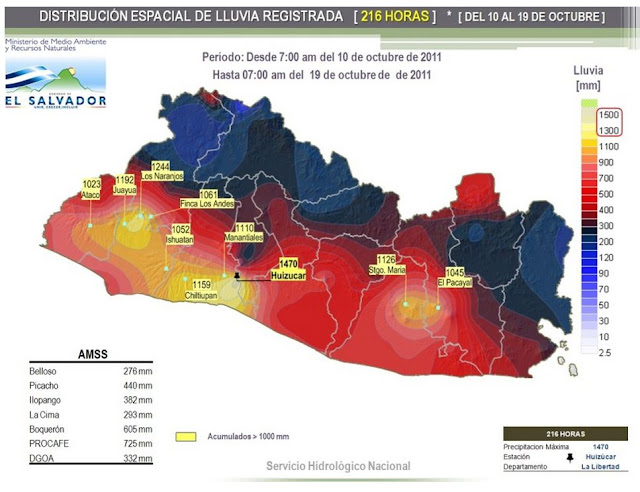
Ten days of rain have produced dramatic rain totals throughout the country as this chart from El Salvador's weather service, the SNET , shows.   The most rain has fallen at Huizucar in the south central part of the country, where an amazing 1470 millimeters (57.9 inches) of rain has fallen.   In a sizable area (orange and yellow on the map), more than a meter of rain has fallen. The rain was still falling today, with  20-70mm of rain falling in locations in the central volcanic chain in the country.  In Puerto Parada, in the western part of the country, officials continued to evacuate inhabitants as the Rio Grande de San Miguel was rising after having already breached its levee in two places.  Rio Paz in Ahuachapan was also overflowing its banks again. On Thursday, however, the entry of a cold front is supposed to mark the end of the rains in most of the country.  Next Monday,  schools will reopen for the first time since the emergency was dec...

Deluge of 2011 -- International aid coming to El Salvador

Image
Source The chart above shows the relative magnitude of the rains of the past 8 days in El Salvador compared to other weather disasters.   While it should be remembered that rainfall amounts are very localized, and that the highest totals occurred in only a very few spots, it is still clear that this has been a very extreme event. At this link you can see a current radar map from weather.com which will play back the weather from the previous 36 hours.  You can also follow links from that page to see the current weather forecast.  Perhaps the most important forecast is the hydrological forecast from SNET which can be found here and which contains forecasted river levels and risks of flooding.  The forecast is in Spanish, but Google translate works pretty well with it for those who need an English translation. International aid efforts are starting to help alleviate some of the needs in El Salvador.  Taiwan, Spain, the United States, Venezuela have all...

The deluge of 2011

Image
As of Monday night, October 17, the rains had not ceased in El Salvador (although things are a little better in the east of the country). The rainfall measured in some locations exceeded an extraordinary 1.2 meters over the past week, surpassing the rainfall total of Hurricane Mitch in 1998. Here are the latest statistics for El Salvador: 150,000 people have reportedly been affected in some way by the rains.   The official death toll has risen to 32.   More than 32,000 people have been evacuated from 149 communities.   Some 21,500 are living in 223 shelters across the country.   More than 18,400 houses have been damaged by floods and landslides. At least 576 landslides have been recorded 10 bridges have collapsed.  See a collection of images of the floods here . Schools continue to be suspended in much of the country until further notice.  A number of schools have been damaged by the flooding.  El Salvador's Nati...

Weather map for El Salvador

Image
The current weather map at this link shows the weather systems which have been affecting El Salvador and also includes weather forecasts for the coming days. The following map shows rain totals across the country on Saturday through Sunday morning:

Blog Action Day -- The Rains and Food

Image
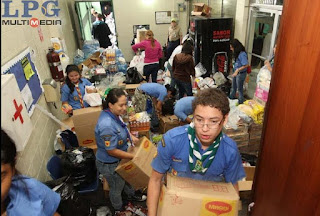
October 16 is the annual Blog Action Day , and the global topic this year is Food.   In light of the weather emergency continuing in El Salvador, I will deal with the implications of the ongoing rains on food issues in the country. The country is under a state of emergency.   In a press conference Saturday night, president Funes called for all elements of Salvadoran society to pull together.   As of tonight some 13 thousand Salvadorans have been forced  to flee their homes, and the death toll has risen to 10.  Emergency efforts to distribute food are underway for families forced from their homes.  Donations are being received from many sources , and the Salvadoran armed forces are participating in distribution of emergency aid.   This picture from LPG shows Scouts receiving and organizing food donations. LPG picture gallery . A tweet from LaPrensa reported that some 4000 pupusas are being made and donated by an association of pupuser...

Update on damage from rains

Image
The rains which started on October 10 have not yet ceased.  President Mauricio Funes has declared a  state of emergency  ( video ) throughout the country due to the rains' impact.  The saturated soil can hold no more of the rain which falls, producing floods and mudslides in at-risk areas.   The death toll has climbed to six.    La Prensa Grafica reported today that 15,000 families have been affected in some way by the rains, 6548 persons are currently in 92 shelters across the country.  Rivers have overflowed their banks in 47 locations, and there have been 384 mudslides.  Schools remain closed. The rains in El Salvador are part of a tropical depression bringing tragedy across Central America as the Boston Globe reports : Heavy rains generated by a low-pressure system hammered Central America for a third day Friday, putting officials on alert in countries where mudslides and swollen rivers have already killed 36 people. At least 21...

Rains pound El Salvador causing flooding and landslides

Image
Heavy rains, caused by a tropical depression off the Pacific coast have caused flooding and landslides in various parts of El Salvador.   School has been suspended in 8 of the country's 14 departments.    The weather system has left 18 people dead across Central America, including two women in El Salvador who died in separate landslides. Certain towns in the department of Ahuachapan in the west are under a red alert for flooding, while much of the coastal region is under an orange alert and much of the rest of the country under a yellow alert.  The rains could continue for another 36 hours. According to La Prensa Grafica , as of 10 a.m. this morning, there are approximately 1800 displaced people in shelters, 10 rivers have overflowed their banks, and there were 26 reported landslides. You can see current weather radar images from El Salvador's national weather agency here .   La Prensa has a map with rainfall totals here  and a gallery of images ...