Posts

Showing posts with the label Children

Judges and child sexual abuse

Image
The dismissal of a case of child sexual abuse committed by a sitting judge in El Salvador has rocked the country.   It appears that just about every sector of society is outraged at the appearance that judges in El Salvador are protecting their own, and not protecting the most innocent of victims.  The case involves Salvadoran magistrate Eduardo Jaime Escalante Díaz, 50 years old, who was accused of sexual assault of a child.   Specifically the allegation is that he enticed a 10 year old girl on the street to approach him and then touched her genital area before fleeing after a neighbor shouted at him. The Legislative Assembly revoked Escalante's judicial immunity from suit so that he could face justice in a criminal court.   Last week, that court ruled that a criminal case against Escalante could not proceed.  The court ruled  that the proof provided by the prosecutors was insufficient to establish the crime they had charged against ...

Child and teen pregnancy in El Salvador

Image
Last week El Salvador's Ministry of Health released a report on pregnancy in girls and teens in El Salvador.   It is a report that shows some progress on this serious issue, but there is still much to be accomplished.  The report titled  More than 19,000 reasons for the protection of girls and adolescents  is available  here . The report focuses on pregnancies during 2017 across El Salvador and compares them to a similar analysis performed in 2015.   The basic data is shown in this table:   As circled in the table, 781 girls 14 and under became pregnant in 2017, including 46 between the ages of 10 and 12.    This number is down from 1,437 in 2015, but is still much too high according to the Ministry of Health and any other compassionate observer. As the report notes, any pregnancy of a girl that young is rape.   But the Salvadoran criminal justice system is inadequate when it comes to crimes of sexual violence....

Sexuality education in El Salvador

Image
A proposed law was introduced in August  in El Salvador's National Assembly to provide programs in schools concerning responsible sexuality and self-worth in order to combat the problem of teen pregnancy in the county.  The draft law defined the programs' scope as dealing with biological, psychological, social, emotional and ethical issues of sexuality within a framework of human rights, prioritizing the elimination of the culture of violence.  El Salvador's legislators quickly tabled the proposed law    That was a mistake.  The problem of teen (and younger) pregnancy in El Salvador is a serious one .   According to the Ministry of Health, between 2013 and 2017, more than 900 girls between the ages of 10 and 17 gave birth each month -- 30 per day.    Between 2013 and 2015, one out of every three pregnancies in El Salvador involved an adolescent mother. On average, 69 girls or adolescents became pregnant per day in 2015, or one pregn...

Teen pregnancy in El Salvador

Image
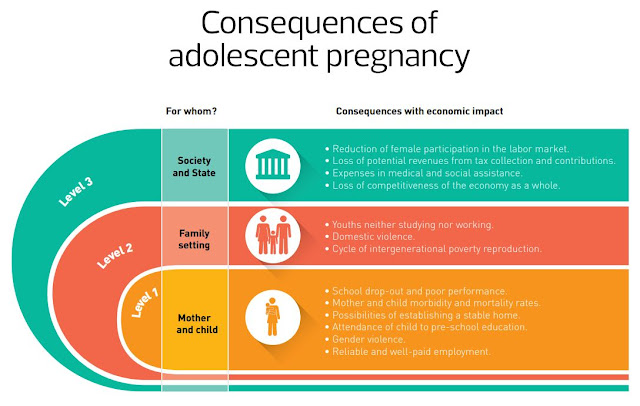
The United Nations Population Fund is reminding us about the high and tragic costs of pregnancies among girls as young as 13 in El Salvador: Pregnancy can be a dangerous time, especially for girls whose bodies are not yet mature enough for childbearing. Globally, pregnancy-related complications are the leading cause of death among girls aged 15 to 19.  Yet early motherhood is common in El Salvador. Between 2013 and 2015, one out of every three pregnancies was to an adolescent mother, according information from the Ministry of Health....  Adolescent pregnancy is one of the biggest sexual and reproductive health challenges in the Latin America and Caribbean region. Factors contributing to the region’s high rates of teen pregnancy include widespread gender-based violence, lack of comprehensive sexuality education, and barriers to sexual and reproductive health services. In connection with its work, the UNPF has published a new document with the testimonies of 14 child ...

Beckham joins campaign against childhood violence

Image
Global football star and UNICEF Goodwill Ambassador David Beckham has lent his name and celebrity to UNICEF's "¿No te indigna?" campaign to end violence against children and adolescents in El Salvador.  Watch his video .

The ongoing story of child migration from Central America

The press continues to cover the story of children coming across the southwestern US border without documents, although the ebola scare and ISIS have pushed the story from the front pages. The newest statistics on the flow of children are out.  US Customs and Border Protection reports that in the year ended September 30, 2014 there were detentions of 68,541 children aged 17 and under who crossed the border unaccompanied by a parent or relative.    This compared to 38,759 the year before. There were a total of  16,404 unaccompanied children from El Salvador in the year ended September 30, almost a 12 fold increase from the number of children detained in 2011.   In addition to the unaccompanied children detained, there were more than 14,000 "family units" of adults with children from El Salvador detained at the southwest US border this year.  Combining just the unaccompanied children with the family units would average out to approximately 124 Salvadora...

Coming of Age in El Salvador

Image
Before he was a professor of social work, my friend Jim Winship did his coming of age in the US Peace Corps in El Salvador.  His work as a community organizer in the La Chacra neighborhood of San Salvador left an indelible mark on him.  More than 30 years later on a Fulbright fellowship, Jim Winship returned to El Salvador, where he began documenting the lives of young people in the country.   That passion has led to the publishing of his book, Coming of Age in El Salvador . The book is divided into two main sections.   After an introduction to the geography and history of El Salvador, Jim presents the life stories of several young Salvadorans and their experiences transitioning into adulthood.   In the second half of the book, he uses those stories to help illuminate discussions of family, education, migration, violence and economic realities.  These are the forces which young men and women must navigate as they make their way from childhood into lives...

The complex problem of child refugees from El Salvador

The Center for Democracy in the America's always-excellent monthly El Salvador Update by Linda Garrett focuses this month on the child migration issue.   After a summary of recent events in Washington and the Northern Triangle of Central America, Garrett writes: While this event has become a crisis for some in the U.S., it is an old story for Salvadorans. Refugees and smugglers have made the journey on the well-traveled trail through Mexico for decades, from the Cold War to the drug war. “This is not [just] a phenomenon,” Salvadoran Ambassador Rubén Zamora said, “It is a system… And like any systemic phenomenon, it does not have just one cause or a simple, unilateral solution.”  Financial and political elites in the Northern Triangle states have historically failed the vast majority of their populations, tacitly encouraging youth and adults to take the treacherous journey north, for underpaid jobs and to send remittances home. The hard-earned dollars not only support the...

Central American presidents meet with Obama as thousands of Central American children are released to parents in the US

Image
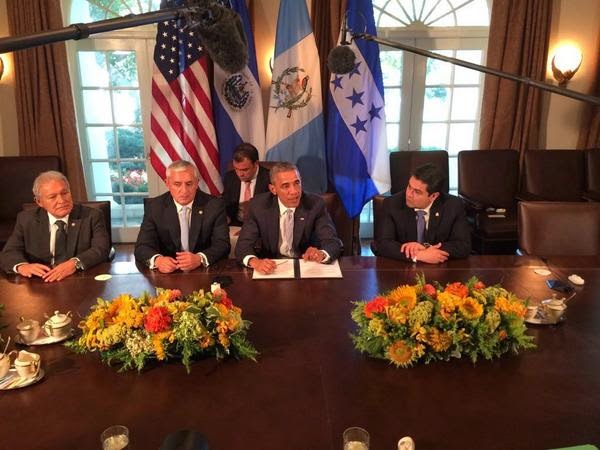
Presidents of El Salvador, Honduras and Guatemala meet with President Obama The leaders of Central America's Northern Triangle came to Washington, D.C. this week to talk about the crisis of unaccompanied minors flooding the southern borders of the US.   Their appearance kept the issue front and center in US media coverage.   In years of blogging about El Salvador, never has there been a period of so much coverage in mainstream US media about the problems of the region. The AP reported  about the meeting of Obama with the Central American leaders: Obama, who met Friday with the presidents of Guatemala, Honduras and El Salvador, said the U.S. has compassion for the migrant children, but those who do not have a proper claim to remain in the United States will be turned back. At the same time, the regional leaders said the president offered them assurances that the rights of those children would be observed.  "It is my hope that Speaker Boehner and House Repu...

The Children Who Can't Leave

Image
For context around the story of unaccompanied minors seeking entry to the US, watch this 20 minute video titled Los niños que no han podido irse / The children who have not been able to leave .   It offers a view of the lives of children in El Salvador, living in poverty, where gangs control their neighborhoods.  (In Spanish with English subtitles.   

Coverage of why children are migrating in great numbers

The flow of unaccompanied children from Central America across the US southern border has produced a flood of news coverage.  Many in the US may be learning for the first time about the situations in El Salvador and the rest of the region which prompt children as well as adults to make the perilous journey north.  Because as many as 50,000 minors have recently been apprehended by US border authorities, the Obama administration faces a humanitarian and political crisis. A good overview of the issues is provided in this piece at Vox.com: 14 facts that help explain America's child-migrant crisis .    Also providing an overview was today's article from the Guardian titled ‘Flee or die’: violence drives Central America’s child migrants to US border , which looks at many facets of the crisis including interviews with children who fled the violence of Honduras. Much of the coverage focuses on telling stories of gang violence in El Salvador as one of the reasons wh...

US Government response to child migration -- a "surge" of enforcement and deportations

#450882778 / gettyimages.com The Obama administration has announced its response to the tens of thousands of unaccompanied children from Central America who are finding their way across the southern US border, and it is not a humanitarian one.   The Washington Post reported : The Obama administration, in a dramatic escalation of its border-control strategy, will seek more than $2 billion in emergency funds to help stem an influx of Central American women and children entering the country illegally, as well as new measures to more quickly deport those already here, the White House confirmed Saturday. President Obama intends to notify Congress of his request on Monday, and the administration will ask lawmakers to modify existing statutes to make it easier to return unaccompanied children to their home countries, an administration official said. The letter the President sent on Monday includes the following measures:  • providing the DHS Secretary addi...

Children fleeing the violence of El Salvador

Researcher Elizabeth Kennedy has been conducting interviews in El Salvador to determine why so many children are leaving the country to try and get to the US. The answer lies in the gang violence which impacts so many communities where these children live. Her piece titled No Place for Childrren: Central America's Youth Exodus was published on the InsightCrime website.  Here is an excerpt: What’s more, after meeting hundreds fleeing areas where their neighbors, family or friends have been threatened or killed, I am convinced the reasons lie in the violence. Among the first 322 interviews I did with Salvadoran child migrants conducted between January and May, the largest percentage (60.1 percent) of boys and girls list crime, gang threats or violence as a reason for their emigration. In the past two years, reports by KIND , UNHCR , the United States Conference of Catholic Bishops and the Women’s Refugee Commission have cited similar numbers from interviews with child migra...

The challenge of teen pregnangcy

July 11 was World Population Day, and the United Nations Population Fund used the day to focus on the problem of teen pregnancy.   The online periodical  ContraPunto collected the statistics  for El Salvador.   In El Salvador, One of every 12 Salvadoran girls is a mother by the time she is 15.    In the poorest areas of the country, that number rises to one in five.   One of every three Salvadoran girls has had a baby by the time she is 18. 29% of all births in the country are to girls between the ages of 10 and 19.     304 girls between the ages of 10 and 14 are heads of households.    4,674 households are headed by teenage girls between 15 and 19 years old. Both the teenage mother and her child (or children) has a significant struggle to avoid a life mired in poverty.   The United Nations Population Fund expressed why it is so important to address adolescent pregnancy in El Salvador and worldwide: Adolescent p...

Epidemic of tooth decay

PBS New Hour aired a   video report this week on a growing epidemic of tooth decay among El Salvador's children. From the transcript of the report: CARL NASMAN: One of the first to notice a decline in dental health was Karen Sokal-Gutierrez, a pediatrician and professor at U.C. Berkeley. She showed us pictures from 30 years ago, when kids had healthy teeth. But just one generation later, the photos look different. DR. KAREN SOKAL-GUTIERREZ: This is a child who has all of the teeth on the bottom rotten and all of the teeth on the top. Years later, when I go into a village and the kid would come flock around us and hug us and smile, that's when I saw, oh, my God, their teeth are all black and rotten. I have never seen this before. What happened? CARL NASMAN: Professor Gutierrez and her team of volunteers work on the ground in El Salvador, training health workers and donating supplies. She estimates that 85 percent of kids in rural areas of El Salvador ...

A good law unfunded

El Salvador adopted child protection legislation last year, designed to help lower incidence of abuse, poverty and neglect.   Last week IPS reported , however, that the law is languishing for lack of funding by the cash-strapped Salvadoran government: The law is an improvement on previous child protection legislation, as it commits the state to ensuring comprehensive child protection and full enjoyment by children of universal human rights, such as health and education. It also includes safeguards against all forms of slavery, trafficking in children, forced and bonded labour, and the use of children in drug trafficking. An effort has been made to integrate child protection measures provided in other legislation, like the Family Code, and to construct a coherent legal system.  The slow rate of progress is attributed by children's rights organisations to a real lapse of interest on the part of President Funes and Finance Minister Carlos Cáceres, whose responsibility ...