Posts

The FMLN legacy

Image
Today is the final day of ten years of the left-wing FMLN in the presidency of El Salvador.   And so we take a look back at the legacy of the governments of the party formed by former guerrilla forces turned politicians after the signing of the 1992 Peace Accords. Unfortunately for the FMLN, the two presidents elected under the party’s banner end up dragging down its legacy.  Mauricio Funes enjoyed high popularity ratings and swept the party into the presidency for the first time in 2009.  Yet now Funes sits in exile in Nicaragua, with orders for his capture on corruption charges outstanding, and with investigative journalists detailing how he lived a luxury lifestyle fueled by public dollars in a secret account of the presidency.  Salvador Sánchez Cerén has not had charges of corruption leveled against him, but that might be the most positive thing one can say about his presidency.  As a leader, he has inspired no one and been largely absent from an...

The US advisor at El Mozote

In a 2007 comment on my blog, Gregory Walker, who was in the US Special Forces in El Salvador,  asserted that a US Special Forces advisor was in El Mozote on the day the military action commenced which would result in the massacre hundreds of children and other civilians: For example, there was a senior Special Forces advisor at El Mozote the day/night of the massacre (and only one). He attempted multiple times to dissuade Colonel Domingo Monterosa to spare the victims. When Monterosa ignored him, the advisor departed by foot and made his way, alone, back to San Salvador. There he made a full report to embassy officials of what the unit and Monterosa were doing in El Mozote. Walker is a former Army Special Forces staff sergeant, who was stationed in El Salvador during the civil war (but after El Mozote massacre) and who led a veterans' campaign to gain official recognition from the US Congress that military forces who died or were wounded in El Salvador were casualties of c...

National reconciliation law stalls

The proposal for a law of national reconciliation in El Salvador, which is opposed by human rights organizations representing the victims and many others, has stalled for now in El Salvador's National Assembly. On Monday, the Political Commission of the legislature held a full day of hearing from a variety of groups representing victims, churches, the military and academia.   Having been widely criticized for spending months drafting the law without any input from victims, the Political Commission could now be seen as staging a one day spectacle to show it had gathered input from all sectors before proceeding to a vote.   Given the number of groups scheduled, presentations were limited to 20 minutes which opponents to the proposal described as insufficient. Going into Tuesday, the question was whether the FMLN would continue to have its 23 vote block support the bill.  The FMLN held a press conference on Tuesday indicating that it was committed to a method...

Featured Salvadoran journalism

I want to highlight two articles this week in El Salvador's two most prominent online sources of investigative journalism, El Faro and Revista Factum In Las pruebas de cómo Mauricio Funes derrochó dinero público , (The evidence of how Mauricio Funes squandered public money),  the El Faro team shares the results of its review of thousands of receipts and accounting records showing how former president Mauricio Funes and his family lived a luxurious lifestyle after coming into office, with trips to DisneyWorld on private jets, purchase of luxury goods, and more.  RevistaFactum published Mara Salvatrucha: “Confiamos en Dios y en Nayib Bukele”    (Mara Salvatrucha: "We trust in God and in Nayib Bukele")  in which Bryan Avelar interviews a top leader of the gang Mara Salvatrucha, regarding the views of top gang leadership in El Salvador.   The interview covers a wide range of topics including their views of the incoming president. 

Disorderly transition of power

From the outside looking in, the transition of power from the current FMLN government to the new government of Nayib Bukele and Nuevas Ideas is not going smoothly.  Following his election, Bukele has continued his rhetoric accusing the current government of incompetence and corruption. For example, yesterday as  video showed heavy rains flooding a hospital  in San Miguel, Bukele  tweeted  "Dejaron nuestro país en ruinas...Qué Dios los perdone."  ( They left our country in ruins...May God forgive them ). The outgoing administration has been accused of last minutes raises and promotion for government employees.   A new union was suddenly approved for workers within the presidency.  The government is blamed for shortages of medicines throughout the healthcare system. Today, the outgoing government delivered what it said were more than 100,000 folios covering 14 ministries and more than 80 government institutions.   The delivery ...

National Reconciliation (or Amnesty or Impunity) Law stalls

Image
The push to approve a National Reconciliation Law in El Salvador's legislature before June 1 stalled on Thursday during the course of a full session of the National Assembly. On Thursday, the chorus of voices against the proposed bill had become ever stronger as international human rights groups, foreign governments, and international bodies added their opposition to the opposition of Salvadoran human rights organizations supporting the victims.   The list of opponents included the European Union, EU member states Spain and the Netherlands, the UN High Commissioner on Human Rights, the Inter-American Commission on Human Rights, and the list went on. The public position of the United States was: The U.S. believes that any national reconciliation law in El Salvador should include a transparent & inclusive process necessary to ensure accountability & protect the rights of victims to seek justice. Transparency, accountability, & justice are all vital for true re...

Can reforms improve the image of Salvadoran democracy?

Image
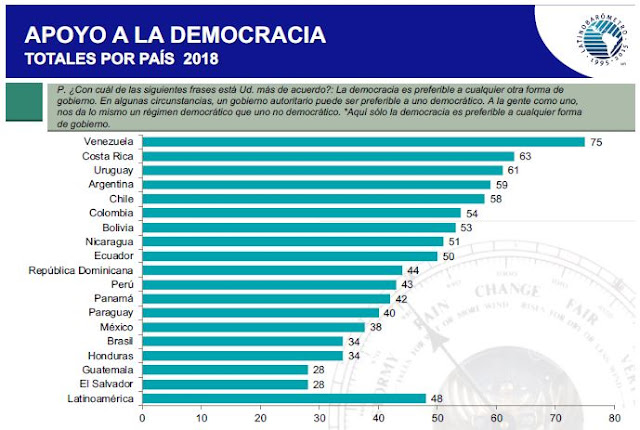
The citizens of El Salvador do not think highly of their country's democracy.   In fact, a majority feel there would be no difference under a regime which was not democratic. These are the results of the most recent polling by Latino Barometro which regularly polls the citizens of Latin American countries on their views of government and the economy.   Salvadorans trail all the rest of Latin America in their lack of support for democracy as a form of government. Only 28% of Salvadorans said that democracy was preferable to all other types of government: El Salvador had the highest percentage of people who  felt a democratic or a non-democratic regime would not make a difference: After Venezuela and Nicaragua, El Salvador had the next highest percentage of people who said their country was not a democracy: Ant not surprisingly, El Salvador had a very low number of people indicating they were satisfied with democracy: These statistic...